

By Kazi Hasnain · Founder, ReformedTech.ca · Updated May 2026
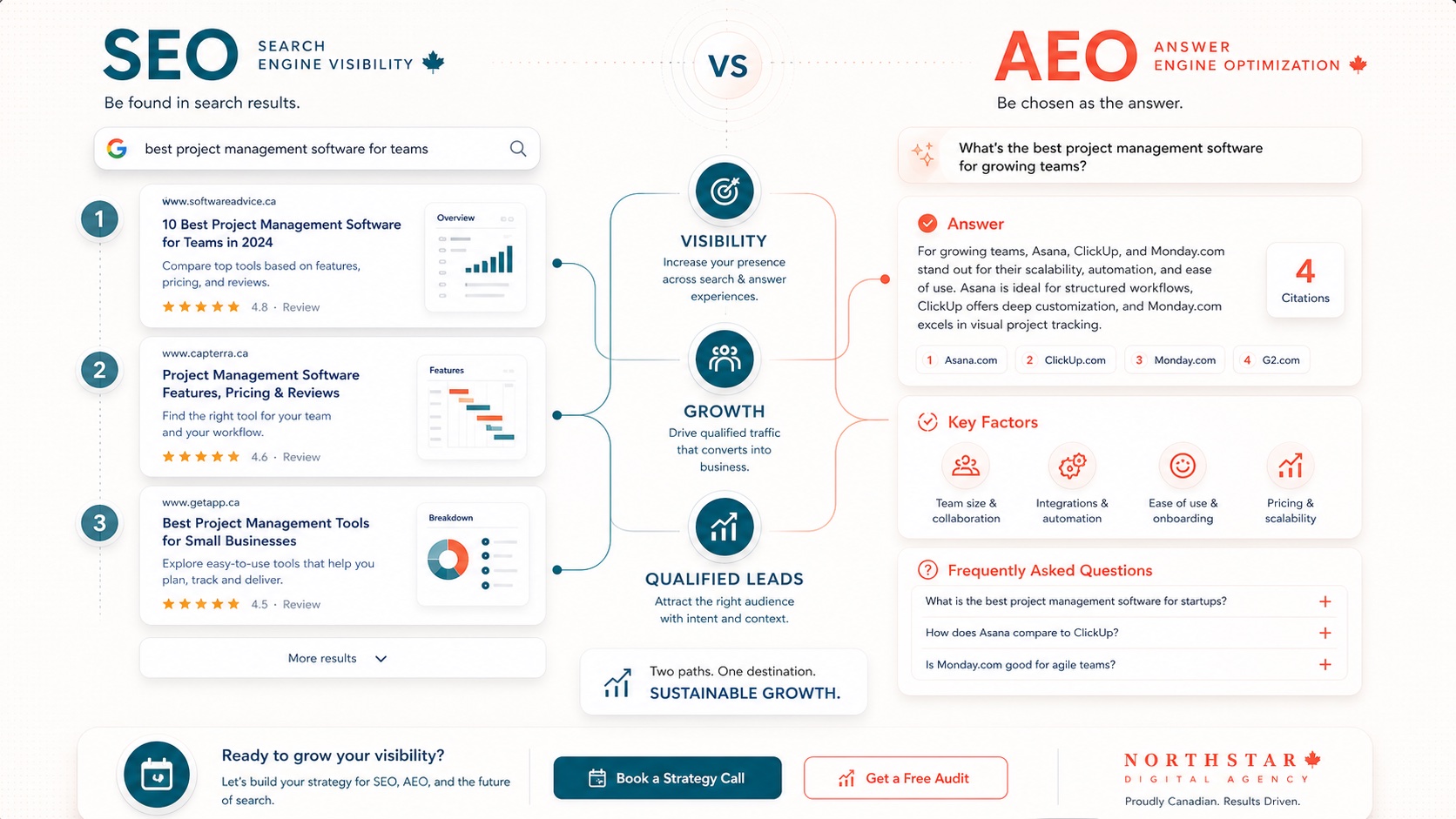
Direct answer: SEO (Search Engine Optimisation) is the practice of ranking your website on Google's traditional search results — the blue links. AEO (Answer Engine Optimisation) is the practice of structuring your content so AI tools like Google AI Overviews, ChatGPT, and Perplexity can extract and cite it directly inside their generated answers. SEO drives clicks. AEO drives citations and visibility inside AI summaries — and in 2026, Canadian businesses need both to be found by buyers.
Key takeaway: SEO and AEO are not replacements. They are layers. SEO earns the ranking. AEO earns the citation. If you only do one, you'll be invisible to a growing share of search traffic.
Table of Contents
- What is SEO?
- What is AEO?
- AEO vs SEO at a glance
- How AI search engines decide what to cite
- Is AEO replacing SEO?
- Should small Canadian businesses care about AEO yet?
- How to start optimising for both (without doubling your budget)
- AEO vs SEO costs in Canada
- Common mistakes Canadian businesses make
- FAQ
- What to do next
1. What is SEO?
SEO (Search Engine Optimisation) is the practice of improving a website so it ranks higher in traditional search engine results — the list of blue links you see on Google, Bing, or DuckDuckGo. It includes technical work (site speed, indexing, mobile usability), on-page work (titles, headings, internal links), content work (keyword targeting, topic clusters), and off-page work (backlinks, citations, reputation signals).
Plain English version: SEO is what makes your site show up when someone searches "web design Kamloops" or "Calgary HVAC contractor."
It's a mature discipline — the playbook is well-understood, and the goal is the same as it has been for fifteen years: rank, get the click, convert.
2. What is AEO?
AEO (Answer Engine Optimisation) is the practice of structuring website content so AI-powered answer engines — Google AI Overviews, ChatGPT, Perplexity, Microsoft Copilot, Google Gemini — can extract sentences from your site and cite them directly inside their generated answers.
Plain English version: AEO is what makes ChatGPT or Google's AI summary mention your business by name when someone asks it a question.
Where SEO competes for ten ranking positions, AEO competes for a much smaller real estate: the 2–6 sources an AI tool decides to cite when it answers a query. The reward is bigger though — being cited inside an AI answer puts your brand in front of someone before they ever click anywhere.
Definition block: AEO is the practice of structuring website content so AI search tools can extract, summarise, and cite it inside their generated answers. It overlaps with SEO but optimises for a different surface — the answer, not the link.
3. AEO vs SEO at a Glance
| Dimension | SEO | AEO |
|---|---|---|
| Optimises for | Ranking blue links | Being cited inside AI answers |
| Primary surface | Google, Bing organic results | Google AI Overviews, ChatGPT, Perplexity, Copilot |
| Click required? | Yes — you need the click | Often no — citation alone builds awareness |
| Format that wins | Long-form ranking pages | Direct answers, FAQs, definition blocks, structured data |
| Measurement | Rankings, clicks, organic traffic | Citation share, brand mention frequency, AI referral visits |
| Time to results | 3–6 months minimum | 4–12 weeks for low-competition queries |
| Risk if ignored | Lose Google traffic | Lose visibility in AI-mediated buying journeys |
Key takeaway: SEO and AEO use overlapping techniques but optimise for different outputs. The same blog post can rank #4 on Google AND be cited inside an AI Overview — but only if it's structured for both.
4. How AI Search Engines Decide What to Cite
AI answer engines don't all work the same way, but they share a few common signals. Based on public statements from Google, Microsoft, and Perplexity, plus what we observe in client AI citation tracking, the patterns look like this:
- Clear, extractable answers near the top of the page. AI engines reward content that answers the question in the first 100 words.
- Structured content. H2/H3 headings, ordered lists, comparison tables, FAQ sections, and schema markup all make a page easier for AI to parse.
- E-E-A-T signals. Experience, Expertise, Authoritativeness, and Trust still matter — author bios, credentials, dated updates, citations to primary sources.
- Indexability across engines. Google AI Overviews use Google's index. ChatGPT search uses Bing's index plus OpenAI's own crawl. Perplexity uses its own crawl plus partner data.
- Topical authority. Sites that go deep on a topic (rather than wide and shallow) get cited more often.
- Recency and freshness. AI engines favour recently updated content for queries where information changes.
Practical implication for Canadian businesses: if your site is invisible to Bing, you are invisible to ChatGPT. Submit your sitemap to Bing Webmaster Tools, not just Google Search Console.
5. Is AEO Replacing SEO?
No. And anyone telling you it is, is selling you something.
Google AI Overviews appear above traditional results — but the traditional results are still there. ChatGPT search cites web pages, but the link to the source is right there in the answer. Perplexity is built around citations.
What is changing is the distribution of attention. Some queries — definitional, comparison, "how does X work" — are increasingly answered inside the AI summary, and the user never clicks through. Other queries — local, transactional, "near me," "book," "buy," "best service in city" — still drive clicks through to websites.
Translated to your business: a query like "what is local SEO" may get answered inside an AI Overview. A query like "SEO Kamloops" will still send the click to your local SEO page.
Key takeaway: AEO matters most for top-of-funnel and educational queries. SEO matters most for commercial and local intent. You need both.
6. Should Small Canadian Businesses Care About AEO Yet?
Short answer: yes, but only if you are already doing the SEO basics well. AEO without SEO foundations is a house with a roof and no walls.
Here's the practical priority order for a Canadian SMB in 2026:
- Foundation first. A fast, conversion-focused website. A claimed and optimised Google Business Profile. Consistent NAP (name, address, phone) across local citations. Real reviews from real customers.
- Then SEO. On-page optimisation for the 5–15 keywords that actually map to revenue. Local pages for the cities you serve. A blog that targets buyer-intent questions, not generic industry trivia.
- Then AEO. Structured FAQs, direct answers near the top of every blog post, schema markup, author bios, and content built specifically to be quoted inside AI answers.
If you skip step 1 and 2 to chase AEO, you'll be cited by an AI engine for a question your buyers don't actually ask, and you'll have nowhere worth sending the few people who do click through.
If you need foundational SEO services before layering AEO on top, that's where to start.
7. How to Start Optimising for Both (Without Doubling Your Budget)
The honest secret is that good AEO content is good SEO content — done with one extra layer of thought. You don't need two teams or two budgets. You need one process that bakes both in.
Step 1 — Pick questions, not just keywords
Stop targeting keywords like "small business marketing." Start targeting questions like "how do I get more leads as a small business in Canada?" Question-format content ranks AND gets cited.
Step 2 — Lead every page with a direct answer
The first 100 words should answer the question. No fluff intro. No "in today's digital landscape." Just the answer. Then expand below.
Step 3 — Use comparison tables, FAQs, and definition blocks
These three formats are extracted by AI engines more often than any other. If a section can be a table, make it a table. If it can be a definition block, mark it visually.
Step 4 — Add FAQPage schema
A simple bit of structured data tells Google and other crawlers exactly which Q&A pairs on your page are answers. It increases both featured snippet eligibility and AI Overview citation likelihood.
Step 5 — Build E-E-A-T signals
Real author bios with photos, credentials, and links to LinkedIn. Dated "last updated" timestamps. Citations to primary sources. Case studies with named clients (with permission).
Step 6 — Track AI citations, not just rankings
Tools are emerging in 2026 to track when ChatGPT or Perplexity cites your domain. At minimum, manually check the top 20 questions your buyers ask and screenshot how AI engines answer them. Repeat monthly.
This is exactly what we build into every site we ship. Learn more about our digital marketing and AI search approach for Canadian businesses.
8. AEO vs SEO Costs in Canada
Both disciplines share most of the underlying work, so costs overlap heavily. Rough Canadian market ranges in 2026:
| Service | Typical Canadian SMB Range |
|---|---|
| Local SEO (small market like Kamloops) | $350–$750 / month |
| Local SEO (Kelowna / Calgary) | $750–$1,500 / month |
| National SEO for SMBs | $1,500–$3,500 / month |
| AEO add-on (when bundled with SEO) | $300–$1,000 / month incremental |
| Standalone AEO content sprint (one-off) | $1,500–$5,000 |
The cheapest way to get AEO is to fold it into the SEO and content work you're already paying for. The most expensive is to wait two years, fall behind on AI visibility, and try to catch up while competitors are already cited.
9. Common Mistakes Canadian Businesses Make
- Treating AEO as a separate budget line. It's a layer on top of SEO, not a parallel project.
- Optimising for ChatGPT without being indexed by Bing. ChatGPT cites Bing-indexed pages. No Bing presence, no citation.
- Stuffing FAQ schema with marketing copy. Schema is for genuine answers, not for sales pitches. Google will demote spammy implementations.
- Ignoring local context. A page that says "we serve Canadian businesses" is weaker than one that says "we serve businesses in Kamloops, Kelowna, Vancouver, and Calgary." AI engines extract specifics.
- Publishing once and forgetting. AI engines favour recently-updated pages. Refresh your top 10 posts every quarter.
- Forgetting CASL and PIPEDA context. When you write content for Canadian buyers, referencing Canadian compliance (CASL for email, PIPEDA for data) is both useful AND a differentiator AI engines will pick up.
10. FAQ
What is the difference between SEO and AEO in one sentence?
SEO ranks your site in traditional search results; AEO gets your site cited inside AI-generated answers from tools like Google AI Overviews, ChatGPT, and Perplexity.
Is AEO the same as GEO (Generative Engine Optimisation)?
They overlap heavily. AEO focuses on being the cited source inside AI answers. GEO is sometimes used more broadly to include any optimisation aimed at generative AI surfaces. In practice, most agencies (including ReformedTech.ca) treat them as part of the same discipline.
Does AEO work for small businesses or only big brands?
It works for small businesses — often better, because the queries small businesses target (local, niche, specific) have less competition for AI citation than broad national queries.
Will AI search kill organic traffic?
It will reduce traffic for purely informational queries — the kind where the user just needed an answer. It will not significantly reduce traffic for transactional, local, or "near me" queries, which are where most small business revenue lives.
How long does AEO take to show results?
For low-competition questions, citations can appear in 4–12 weeks. For competitive topics, expect 3–6 months.
What's the single most important thing to do for AEO right now?
Add a direct, quotable answer in the first 100 words of every key page. That single change moves the needle more than any other.
Do I need new tools for AEO?
Mostly no. Your existing SEO tools (Google Search Console, Bing Webmaster Tools, Ahrefs or Semrush) cover most of what you need. New AI citation tracking tools are useful but optional in 2026.
11. What to Do Next
If you're a Canadian business owner and you've never thought seriously about AEO, here's the honest 30-day plan:
- Week 1: Audit your top 10 pages. Add a direct answer in the first 100 words of each.
- Week 2: Add FAQPage schema to your service pages and top blog posts.
- Week 3: Submit your site to Bing Webmaster Tools and verify indexing.
- Week 4: Manually search the top 20 questions your buyers ask in ChatGPT and Perplexity. Note who's being cited and why.
If that sounds like too much, that's exactly what we do every day for businesses in Kamloops, Kelowna, Vancouver, Calgary, and across Canada.
Book a free 20-minute AI search visibility audit
We'll show you which AI engines are already citing your competitors, which questions your business should be cited for, and the fastest path to getting there. No pressure, no boilerplate proposal.
About the author
Kazi Hasnain is the founder of ReformedTech.ca, a Canadian digital agency based in Kamloops, BC. ReformedTech helps small and medium-sized businesses across Canada with website design, SEO, AEO, AI chatbots, and lead generation.